Chapter 2
Hold
About 45 min read
He was three ramps down toward Tectonic’s chamber before he noticed he’d been walking fast.
Nothing had hurried him. The amber had lifted to its day-tone while he dressed, the campus making its slow handoff between night-stone and morning-stone, and he’d eaten a piece of bread on the edge of the bed without tasting any of it. Today was the all-element day. Promyse had said it once, half-shrug and half-warning, which was how she named everything. All four, in order, the session tiles walking students from domain to domain across the day in a rhythm nobody had needed explained twice. Yesterday had been a choosing day. He’d chosen Air and then Water, leaving Earth and Fire to a day that did not let you choose.
Earth first. That was why his legs were out ahead of him.
The inner path ran through the dorm corridors and the lower halls, narrowing as it went, the floor turning comfortable underfoot in a way floors did not. The amber thickened around him.
The weight arrived first. The earth domain’s settling pressed against him the moment he was inside it, a pressure with nothing behind it doing the pressing. He weighed more and less at once. Gravity had an opinion down here and had not shared it.
The ramp carried him deeper on low risers, and the campus above with all its noise and weather went quiet by degrees as he dropped. The air here had presence. Something residual and patient in it.
Tectonic’s teaching space was the first room at the academy where Eli had not felt the need to prove something. He still didn’t have the full shape of why. The walls were stone, thick enough to block every sound from outside, and the floor was the same smooth stone carried upward into surfaces that held the body differently than chairs did. Deeper, wider, shaped by something that understood how a person sat. Amber light filled the room from no source he could find. There were no shadows.
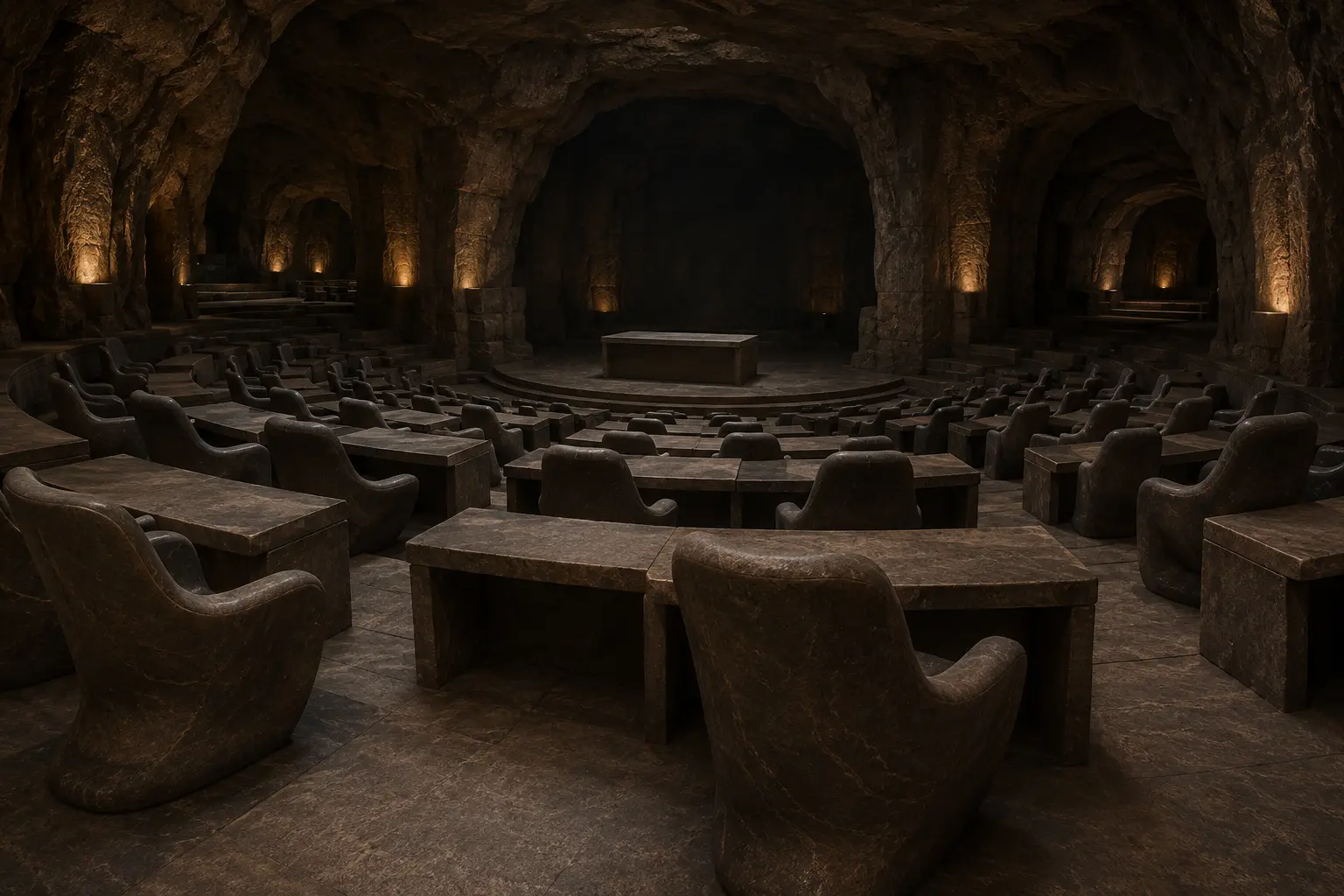
Promyse was already there. Same seat. Two rows up, offset right, clear line of sight to the door. Light brown hair that couldn’t decide if it was blonde, a face that welcomed more than anything else. She looked up when Eli entered and sat up straighter.
He’d known her three weeks. Long enough to remember the second day, before he had any sense of who else had arrived: Promyse walking up to him in the corridor, the smile arriving ahead of her greeting, which included Promyse — with a y. In case you need to write it down. Said half-bracing, half-shrugging, pre-apologizing for a misspelling she’d long since come to expect. The joke landed late. There’d been nothing in his pockets to write it down with. No bag, no books. She’d known. He hadn’t, in three weeks, forgotten the y.
She looked him over, the same short scan as every morning. Three weeks of it and he still didn’t know what she was checking for.
“You dried out.”
He settled into his usual seat, same section, one row below hers, set into the stone. A low pulse came up through the surface to meet him, something between vibration and pressure, the same settling as every session, and his shoulders dropped before he decided to let them.
Tectonic arrived.
Not entered. There was no door opening, no footstep, no displacement of air. One moment the front of the room was empty. The next, he was there — large, skin with the texture of worn stone, every movement carrying weight. His clothing looked forged, layered metal and stone, with patches of moss along the jawline in a shape that suggested a beard if beards were geological events.
He looked at the room. It was still filling, students finding their seats. His gaze moved across them without haste, and when it reached Eli it paused. No longer than any other pause. Eli felt it anyway: the attention of something that had been patient long before there was anyone to be patient at.
Tectonic spoke. One word, hold, and then nothing. The room took it without comment and without echo, as if the word had been sitting in the walls already and he had only pointed at it.
Then he held up a stone.
It was the size of a large watermelon, gray, dense, unremarkable, the kind of thing you’d walk past on the stone plains without a second look. That he could lift it at all was the first thing Eli noticed. That it cost him nothing was the second. Tectonic cradled it between both hands, palms flat against the sides, and the stone that should have been impressive looked smaller against his frame, held open where every student in the room could see it. For a long time he did nothing else. He held the stone. The room held its breath. Eli counted to ten, then twenty, then forty, and then stopped, because counting was the wrong thing to do in this room.
His hands pressed inward, slow. Geological pressure, the kind that takes mountains and makes valleys. It came from both sides, steady and even, and Eli watched a crack form: a single straight line running up the center of the stone, so precise it looked drawn. To find that line you had to know where to press and how much, so the stone came apart along its own seam.
The stone opened.
A shell coming apart to show what it had been keeping. The two halves came away, one in each hand, and the room changed.
Inside: crystal. Formations that caught the amber light of the teaching space and fractured it into something the room had never held — prismatic, sharp, alive with color that had no business existing inside anything that gray. The crystals climbed the interior walls of the geode in clusters and spires, each one taking the sourceless amber and returning it at a different angle, a different temperature of light.
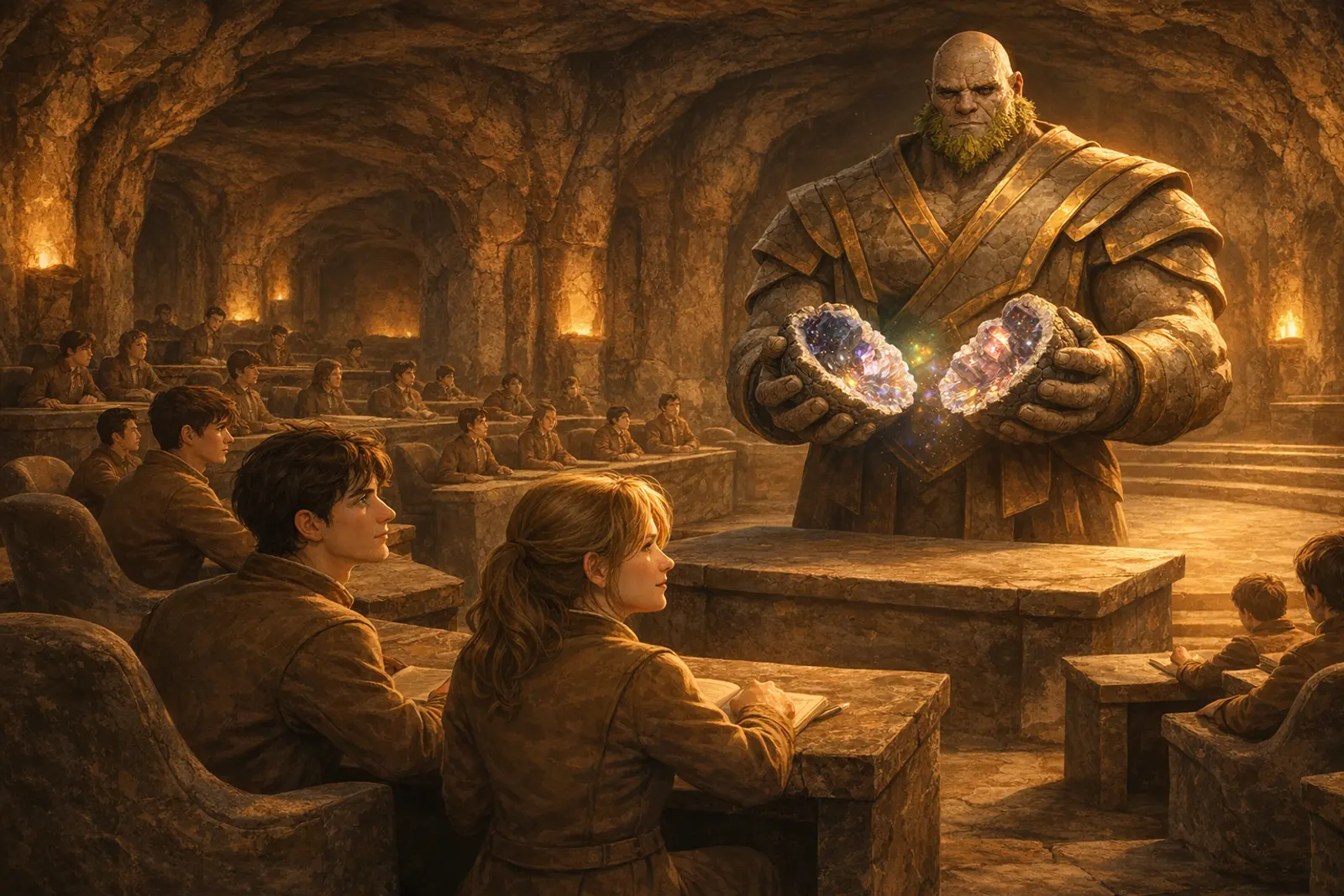
Tectonic set the two halves on a low table that rose from the floor. He said nothing.
Eli’s hand moved toward a pocket before he caught it. The old reflex: keep this, carry it back to people who would never otherwise see it. His palm found fabric. The light kept doing what it was doing, unkept.
A student near the front whispered something he didn’t catch. The girl two seats over had stopped chewing whatever she’d brought in. Eli sat with it.
Tectonic watched them look at the geode. He did not look at the geode.
Promyse, afterward, said nothing helpful at first. She gathered her things. There were no things to gather; she made the motion anyway. Then she fell into step beside him at the door, tugging at the cuff of her left sleeve as they walked.
“Any thoughts?” he asked.
“Several. None of them useful yet.”
The useful version came later, usually a day later, and arrived as one sentence delivered like she’d thought of it that second. He had learned to wait.
He didn’t, this time.
“I had one,” he said. “Probably useless.”
“Try it on me.”
“I don’t think hold was only about the stone,” he said. “He held the rock. He held the line where it would open. And the —” He lost it. “The whole time, he had to keep hold of how.”
Promyse walked a few steps on that. “He wasn’t showing us a rock.”
“That’s what I meant.”
“It’s not what you said.” She tugged the cuff again, slower. “Works on people too, I’d guess.”
The corridor was thinning out ahead of them.
“I take it back,” she said. “One useful thought, after all.”
The rest of the day ran as Promyse had said it would. Windborne through the mid-morning, Tide into the afternoon, then Inferno’s caves at the day’s end. Windborne and Tide he’d had yesterday. He went to both again and let yesterday’s body do most of the work, recognizing the shapes of the lessons without having to interpret them. Similar, not the same. At Tide’s, the drip found him inside a minute, same shoulder, same patience. He let it land. One breath, cold running down under his collar, and then it was just water, going where it had been going anyway. Tide did not look at him, and the next drop fell somewhere else.
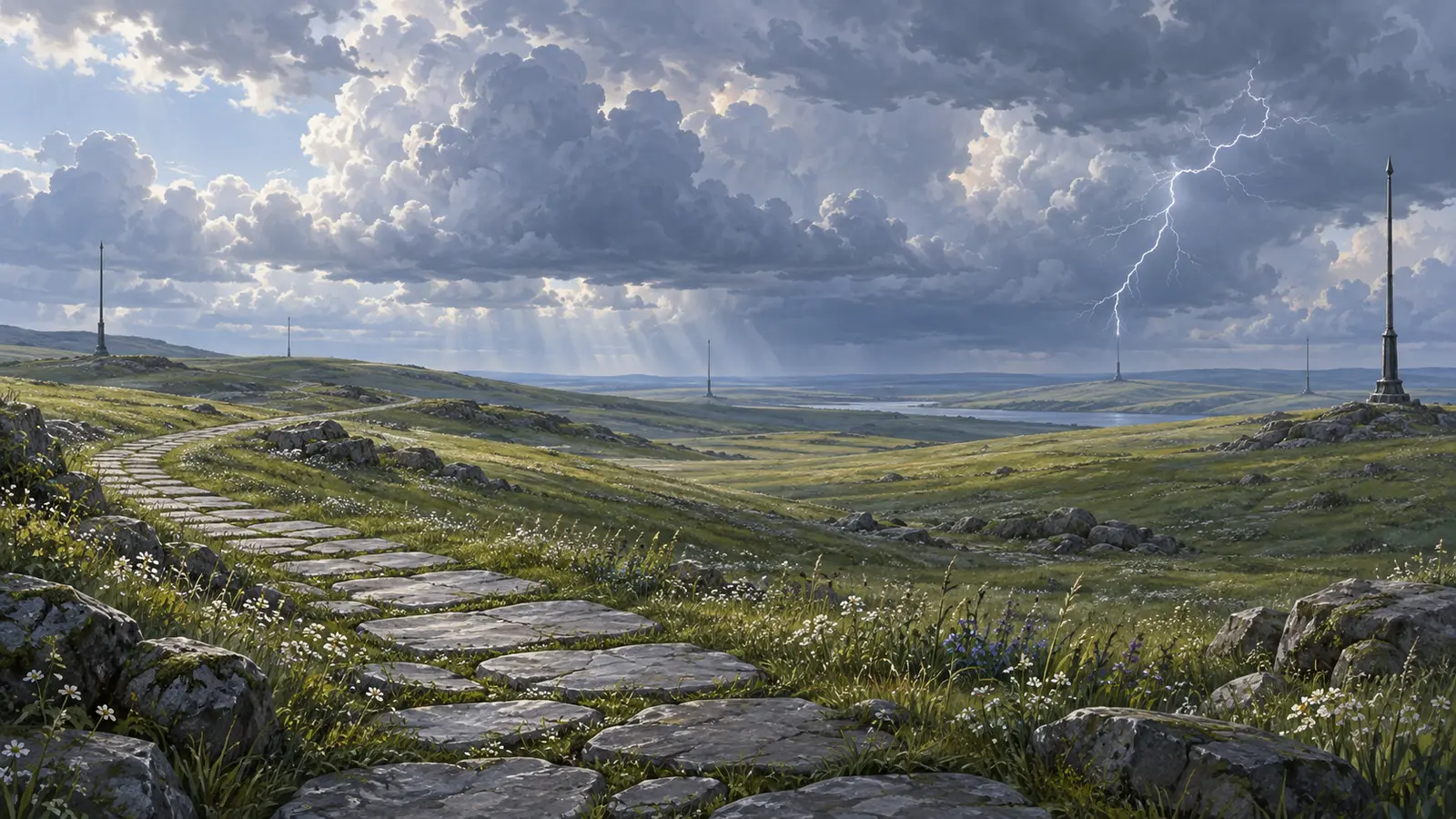
The path west to Inferno’s caves was the longest of the four. The Lightning field’s inner arc came first, flat worked stones in short grass, the rods spaced across the low hills well off the path, static gathering in his hair where the arc ran closest. He kept his eyes on the stones underfoot. By the time the path tightened westward, the grass had thinned to nothing and the ground became scorched earth, warmer than the campus baseline by degrees that came up through the soles of academy shoes. The cave mouth rose tall out of the mountain’s flank, cathedral-height, the interior already throwing back whatever fire Inferno had lit inside.
He crossed the threshold onto the worked obsidian floor.
Inferno stood at the center of the room. Her hair moved with its own logic, flames styled into something that should not have been elegant and was. She wore obsidian and something that flowed like hardened flame. She looked the incoming students over once and did not look again.
“Today,” she said, “you receive. I know. Terrible news for some of you.”
Students settled along the obsidian benches set against the curved wall. The all-element day had moved the whole student body through the domains in sequence; by afternoon, the class was full. Cesayal was three benches over, hands loose in his lap. Solen sat nearer the center than the wall, his usual choice when he wanted to see everything. Drea had taken the bench nearest the cave-mouth, her jacket cuffed and one foot braced against the floor for a launch she hadn’t decided on yet. Rowan was near the far wall, composed, present. Promyse, Eli registered without making anything of it, was not here.
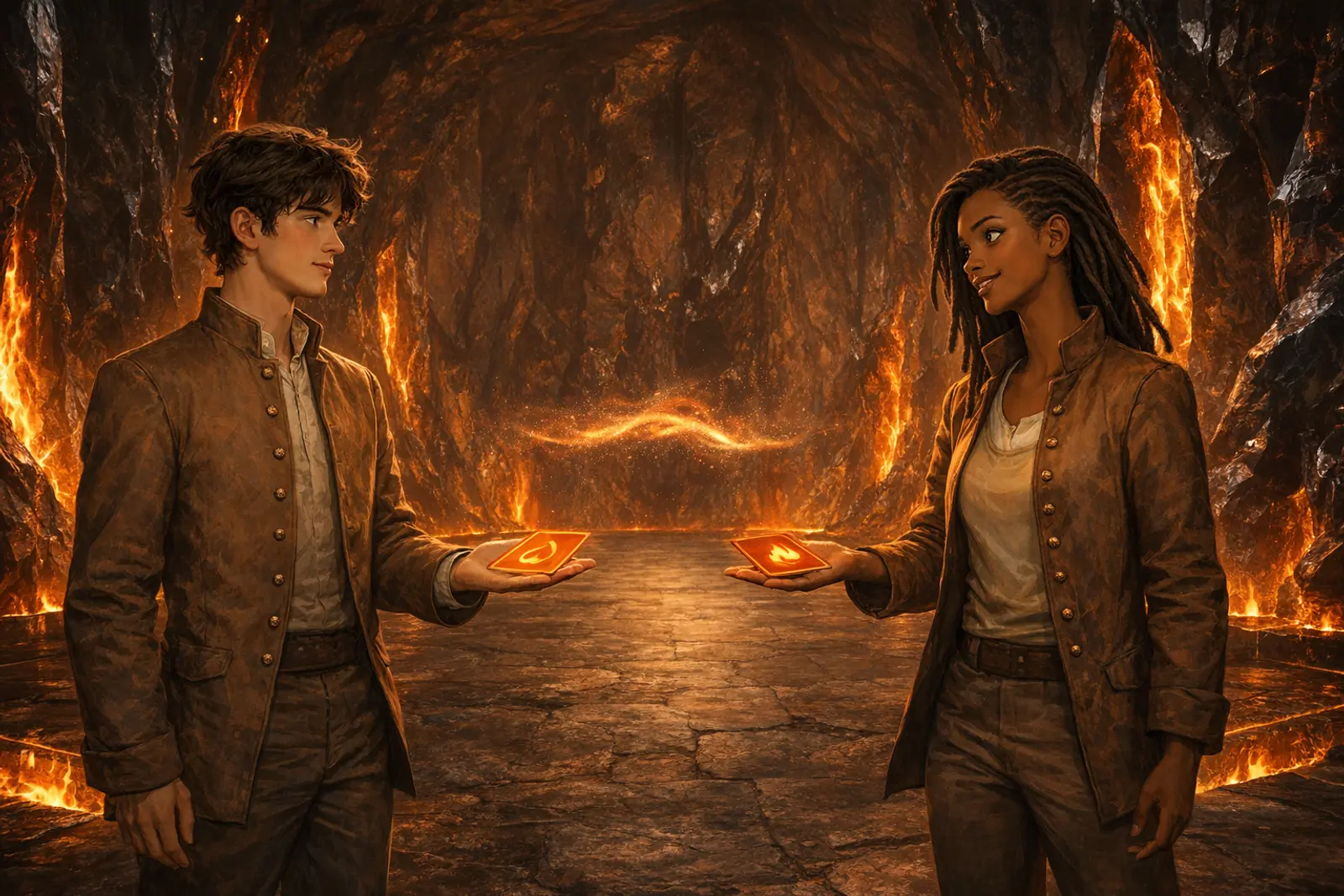
Inferno raised her hand. Between thumb and forefinger she held something that had not been there a moment before: a small flat rectangle the size of a playing card, edges crisp. The surface caught the cave’s red-orange light and threw it back at a single clean angle, as if the card had decided which way to be seen.
“This,” she said, “is what magic looks like once somebody’s told it to hold still.” She turned the card so they could see both faces. The front carried a stylized image, a flame, narrow and reaching, drawn in lines precise enough to read as a written word. The back was uniform dark, the color of cooled obsidian. “Potential, wearing a shape. You’ll make them yourselves one day. Today you hold one, and you find out what it asks of the body doing the holding.”
She moved across the room and gave the first card to Cesayal, who received it with both hands and turned it over with care. The flame on his was tall and pointed, drawn with a flicker mid-line.
She moved on. Solen received a card and held it without looking at it. Drea received one and looked at it at once. Rowan accepted hers with the precision Eli had come to expect.
When Inferno reached him, Eli looked up. She held the card out and waited until he took it before letting go. The image on his was the inverse of Cesayal’s. A flame in outline only, drawn around a hollow. The shape of reducing a flame.
She finished the distribution and returned to the center. “Two kinds. Both cards. Both magic that’s agreed to wait. The difference is what they want from you when you want something from them.”
She held up one finger of each hand. The fire behind the protective crystal behind her pulsed once, brighter, then settled. “A torch card wants to give. Everything in it moves out. Carry it and don’t ask, you’ll feel nothing at all. Ask it, and the heat goes from the card to whatever’s standing in front of you.” Her other hand turned, palm up. “A smother card wants to take. Everything in it moves in. Carry it and don’t ask, same nothing. Ask it, and whatever heat was in front of you comes to the card and quits.”
Cesayal said it low, to himself first and then to the room. “And if a torch and a smother meet?”
Inferno did not turn her head. “That’s the lesson, and I’m not spoiling it for you. Pair off. Find the card that isn’t yours; it’ll tell you which one that is. Stand close enough that the air between you is a shape you’re both standing in. Then ask together.”
The room moved.
Eli looked at his card again. The hollow flame caught no light, gave no heat. He felt nothing of it in his palm. Around him, students were standing, drifting toward partners. Solen caught Eli’s eye and raised his card so Eli could see it: torch, the flame drawn full. Then he was already turning toward Rowan, who held something Eli couldn’t make out. The pair-off was happening fast, and most of it was happening across the room.
Drea was in front of him before he’d decided to move.
“You’re smother,” she said. She held up her own card, a flame full-drawn. Torch. “I am very much torch. Which is funny, because you ask me yesterday, I tell you I’m the opposite of that.”
“Inferno picks.”
“Inferno picks.” She gave a small laugh with no amusement anywhere in it. “All right. Stand.”
He stood. She placed herself across from him at what felt like an arbitrary distance, a body’s width and a half, the air between them carrying the cave’s heat and nothing else yet. He held his card out, the hollow flame facing her. She held hers, the full flame facing him.
“Now what.”
“She said to ask.”
“How does one ask a card?”
He didn’t know. He looked at the card and thought about the hollow flame, what it wanted, what kind of attention it expected. Nothing changed. Drea’s card put out a small flame with faint heat into the air between them, a thing he registered as much in his face as in his palm, and he understood without naming it: she had asked hers, and his hadn’t answered.
He tried again. He thought about the word. Smother. How it sat in the throat. The shape of receiving. Then he perceived the card change against his palm — no motion in it, but a kind of attention, as if it had turned to face him from inside its own surface.
The back of his neck went cold. Eighteen years of holding things. Not one of them had ever noticed him back. This one had. He had asked, and something had answered. His hand wanted to put the card down. His hand wanted to never put it down. Neither one moved.
Then the air between him and Drea began to thicken, the heat she was producing pulled toward his hand and stopped at the card. The hollow flame stayed hollow.
“You did it.” Drea watched the air between them like weather. “I feel it cooling.”
“I don’t feel it at all.”
“You’re not supposed to. Smother. It eats the heat. It doesn’t route it to you.”
“Guess that’s good.”
“This is what Water students sound like all the time. You’ll get used to it.” She tilted her card a fraction; the heat between them pulsed, fluttered, held. “There. Equilibrium. That’s what she means. Your card eats what mine makes. We are now thermally a pair.”
Across the room, Solen and Rowan had it already, and it had cost them less. The air between them stood in a thickened, heat-shaped column that neither of them was reaching toward. Solen’s expression was a brightness Eli had not seen on him in any other room. Rowan’s mouth had a new line at the corner of it.
Two benches over, a pair had failed, the heat moving and not balancing, the torch student frowning at the medium flame emitting from the card. It was the boy from the food counter, the ridges where his eyebrows were still filling back in plain to see in the cave-light. The smother student leaned away from a heat that had gone somewhere it wasn’t wanted. Inferno was at their side before either of them noticed her arriving.
“Easy there, Kindling.” The name came out slow and smoky, half endearment, half diagnosis. “You already gave this room your eyebrows. It doesn’t need the rest of you.” She never touched the cards. She moved the smother student two inches forward, and the heat re-settled between them like something that had been waiting to be told where to live. “There.” The word stretched, pleased, almost fond. “Hold it just like that, and we’ll make a fire student of somebody yet.”
“It’s a geometry,” she said, more to the room than to the pair. “The cards already know what they are. That part’s settled. What’s left is arithmetic, and arithmetic’ll tell you whether the two of you agreed on the terms or just happened to be standing close.”
When she reached Eli and Drea, she stopped longer than she had stopped at any other pair. She looked at the air between them; she looked at the cards; she looked, for a fraction of a second, at Drea. Then she nodded once.
“Sufficient,” she said, and moved on. Half a step past him, without turning her head: “Second ask, though. I was counting.” The drawl put a shine on it and a hook under it. “Do it in one count for me sometime, Hot Shot, and I’ll get interested.”
She was three benches away before he found anything to do with his face.
“Sufficient.” Drea, without looking away from her card. “Translation: I am surprised neither of you has set the room on fire.”
“I’m holding the absorbing card.”
“My point exactly.”
They held the equilibrium another minute and then he stopped counting. The heat moved through the geometry of the air between them. He felt none of it on his skin. He got all of it through the card, where the heat stayed down in the mass of it and never reached the surface. Then both cards expired and were gone. Eli looked at his palm. His fingers still held the shape, curved around nothing. He caught himself wanting one that stayed, and wanting it more than he wanted Drea to see him wanting it.
Inferno spoke once more from the center of the room.
“Two days from now, you decide.” She looked at the room without urgency. “And I’d hate for any of you to walk in there thinking the question is which of these you’d rather be holding. The card’s not the question. You are. Some of you have been receiving for weeks and haven’t noticed. Some have been giving. Some have been doing both and calling it confusion. The cards were practice for noticing.”
The session ended as Inferno’s sessions ended. The fire behind the crystal pulsed once, lower, and the cave let the room go. Students rose and filed out.
Drea bumped Eli’s elbow on the way to the cave-mouth. “I’m sure dinner will have the brown thing. We have to call it something else, and I’m working on a name.”
“You have a name for the brown thing.”
“I will reveal it soon,” she said mysteriously, steepling her fingers. “Possibly at dinner.”
She went ahead of him out of the cave. Eli paused at the threshold and looked back. Inferno stood in the center with the cave settling around her, the obsidian throwing back her shape doubled and again. She was not looking at him. She was looking at a new card in her hand, and as she turned it the card caught the cave-light and threw it once against the wall — a clean angle, aimed, in his direction.
He walked out into the scorched-earth path and let the heat fade off his back, and by the time he reached the Lightning field’s inner arc the day was tipping toward evening.
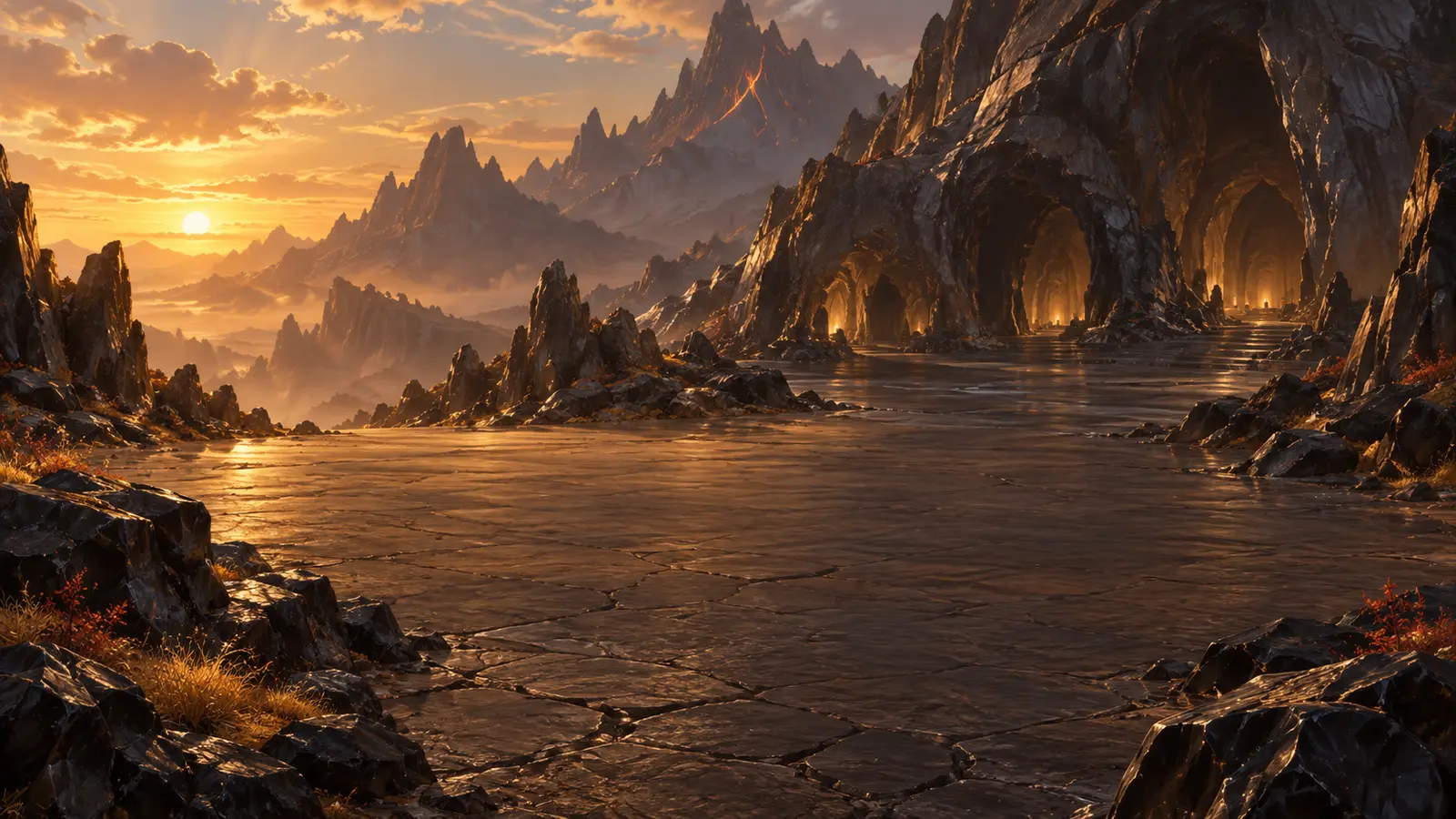
The dining hall was the most human-scaled space on campus, which was not saying much. The tables ran a little too wide, the benches a little too deep, the proportions built by someone, or something, that had been given the concept of “dining hall” and interpreted it with enthusiasm. A bench that seated two at a human table seated one and a half at these. Everyone sat either too close to their neighbor or a foot too far from them, with no comfortable middle.
Forty-something students, give or take whoever was staying after class or avoiding the noise. Neutral ground. Food appeared without explanation on a counter that was full and never visibly restocked. The first week it had been unsettling. Now it was the counter.
He was reaching for the brown thing, approximately a potato by shape and weight and the confidence with which it sat on the plate, when Drea materialized next to him.
“What do you call it?” she asked. It was not really a question.
“Approximately a potato.”
“It is not a potato.”
“I said approximately. I know what it’s trying to be.”
“That’s worse.”
Promyse arrived on Eli’s other side, already loading her tray. “Is the brown thing the brown thing again.”
“Brown thing is the brown thing.”
“We need to name it,” Drea said. “I refuse to keep calling it ‘the brown thing’ for the rest of my life.”
“Brownie,” Promyse offered.
“That’s a dessert.”
“Yeah.”
“Aproxitato,” Drea said.
“Aproxitato?” Eli said.
“Approximately a potato. Aproxi-tato.” She rolled it, mock-Italian, committed instantly. “It even sounds like an apology. Like a potato apologizing for not being a potato.”
“That’s because you’re saying it like it’s apologizing.”
“Yes. That’s the point. Aproxitato.” She raised her tray a fraction, like a toast. “Long may it sit on the plate.”
“Long may it sit on the plate,” Promyse said, deadpan.
Then they scattered.
Eli ate and listened. At least there was salt in a bowl at the table. A roomful of people who had spent the day doing impossible things, now eating and talking too loud. Someone two tables over was describing a water session, both hands going. Whatever Tide had taught recently involved a lot of horizontal gestures.
Across the hall, at a crowded table, someone was performing a complaint about Inferno. “She made me hold the form for several minutes and then said adequate and I swear the room got two degrees hotter.” Laughter.
“First ask,” a girl down the same table was saying. “I felt it turn around.”
“That’s a lie.”
“It is not a lie.”
“Five asks, for me, and then adequate.” The boy at the end of the bench said it with dignity. “And I’m going to keep saying three until somebody beats it.”
Five got a round of applause. Eli counted his own again without meaning to. Two.
Somewhere down the same table a boy said he wanted to go home. Not the joke version. He said it again, louder, and his breathing had gone wrong somewhere in it, and the quiet went out from him in a ring. Somebody put a hand near his shoulder and didn’t land it. He left his tray where it was.
At the table behind Eli, Paddy, the Newfoundland kid he’d known by name since week two, was telling a story about his uncle Will and a goat. The story had three side-stories already, two of which had branched without warning and one of which had rejoined an earlier branch without explanation. The students near him were laughing in places that did not seem to require a punchline.
From somewhere closer, a quip landed. “That’s the third time you told that one, Paddy, and the goat gets bigger every time.” Flat, and it landed on a beat Eli hadn’t heard coming. A kid laughed and almost spat his food.
Cesayal’s voice carried from two tables away, low and steady, with a cadence Eli had been trying to place for days. He put weight on words Eli would have let go past. African, maybe. Eli wasn’t sure. He was explaining something to a water student. “— what a force becomes when it has no direction. That is the question, is it not?”
“I asked when the wind session was,” the girl said.
Cesayal considered this. “That is also a question.” He sat straight-backed, squared to the conversation. He took a bite of aproxitato and kept talking.
Don De Ciavolière arrived audibly, as he did everything. He crossed the dining hall with his chin up and every button of the uniform done. Tall, well-built, olive skin, dark hair, a face that was handsomely aware of itself. The jacket on when half the room had taken theirs off, because Don came out more finished than the room required. He slid onto the bench beside Eli, took up a little more space than was available, and began talking.
“Has anybody,” Don said, to the bench and a little past it, “worked out the toilets? Because I’ve asked around and I’ve been given nothing. Start with the box by the basins. Wrapped things, two sizes.” He held up a thumb and forefinger, close together, for the bench. “As a hand towel it is inadequate. You get through two of them drying one hand. And there’s nowhere to put them after, so you end up standing there holding them, looking for a bin that isn’t there.”
A girl further down said, without looking up from her tray, “It’s in ours too.”
Don considered this. “Maybe lifting one out of the box triggers the incineration mechanism in the toilet room.”
“I can confirm it’s not related to the incineration mechanism.” She took a bite and finished it before going on. “It’s for a female mechanism. The bin’s under the counter.”
Don’s face went red. It started at the collar and went up, and for once nothing came out of him in the right order. “Right,” he said. “Yes. Obviously.” The bench loved it. Eli looked at his plate.
“Well, after,” Don said, with most of his rhythm back. “How does it know you’re out.”
The boy at the end of Eli’s bench, who had been timing the toilets since the first week and told people so, said he had figured out when it started.
“That is a substantially less useful answer.”
“After the door. Not before. I left a door open in one for most of a class and nothing happened.”
“You stood staring at a toilet for nearly a whole class?”
“Tectonic was boring that day.” He straightened and did the voice. “Hold. How many times with that one? Somebody had to check it out anyway.”
Don turned on Eli. He had found a witness. “Eli. Tell them.”
“You tell them. You were the one who —”
“I was the one who found out. You were behind me. Tell them.”
So Eli told them. The first week, the bathroom down their corridor, Don ahead of him and Eli waiting his turn, neither of them knowing anything. Don had come out fastening the last button of the jacket, which he had worn to the toilet, and while he was at the sinks the stall behind him had made a sound.
— A muffled whump behind a shut door, as Don washed up. Eli had just walked up to the door. Heat rolling out from a horizontal vent at foot height, dry as an oven opened, and smoke lifting from behind the toilet when the door swung. Don turning back toward the door he had closed, every bit of color gone out of him. —
“You went white,” Eli said.
“I did not go white.”
“You went completely white. You just stood there.”
“I had just been in there,” Don told the bench, in the voice of a man reporting an atrocity. “And I want it on the record that it was entirely normal other than the incineration bit. I didn’t break it.”
“That’s how we worked it out. Nothing while you’re in it. Then you leave, and it —” Eli didn’t have a gesture for it. “Does the thing.”
“Cleans. It’s Fire. It’s got Inferno all over it.”
“We don’t actually know that.”
Don had gone looking for the mechanism that first morning, as if it would be labeled, and had found the box by the sinks instead.
Don’s rhythm had come back with the audience. “And then, Eli, it was your turn. Tell them how long you stood outside that door before going in.”
“I don’t remember.”
“Long enough. I counted.”
“I kept telling myself it waited until you were out,” Eli said.
“It was your turn to just stand there.”
“I had to make peace with stepping into an incinerator,” Eli said, “because I had to go.” Which was the whole of it, and the bench laughed harder at that than at the toilet.
Don let it land and moved on without a seam. “Listen, Eli.” He said the name every few sentences. He had been saying it since about forty-five seconds after he learned it. “I have a theory about Windborne. The whole cryptic-teacher act? It’s a cover. Evidently, and I have asked around about this, there is no lesson. They are simply chaotic. Pure chaos, dressed up as teaching.” He paused for emphasis. “I’ve thought about this.”
“How long?”
“What?”
“How long have you thought about this?”
Don considered. “Long enough.”
He had not thought about it long enough.
Across the room, Rowan sat alone with a thin bound sheaf of academy paper, the sort that turned up in stacks on the counter and that nobody else had found a use for. The dining hall’s amber kept finding the red in her hair. She was pretty. He noticed it before he’d decided to.
She was reading. Or she was holding a page so she could watch a room. He couldn’t tell.
Their eyes met once across the noise. She held it. Eli looked back down at his plate faster than he meant to. When he glanced up she had gone back to her page.
Solen appeared at the edge of the table and sat down beside Don. Don moved over for him without appearing to notice he had. Solen listened to the theory about Windborne for approximately ten seconds, then redirected it.
“That’s interesting. I think you’re half right.” He caught Eli’s eye as he said it. The corner of his mouth moved. Barely.
“Half right is — listen, Solen, half right is fully right with context missing.” Don leaned forward. “Naturally, you have the context I’m missing. Go on.”
“I think the chaos is real,” Solen said. “I think the lesson is also real. I think Windborne doesn’t know which one they’re doing at any given moment, and the students who figure that out are the ones who learn something.”
“That’s exactly what I said.”
“It’s not what you said.”
“It’s what I meant. Eli, isn’t that what I meant?”
“It’s not what you said,” Eli said.
Don waved this away. Eli watched Solen guide him sideways into a different conclusion without Don noticing the turn. Solen made the table the right place to be sitting.
The session tiles in the corridor outside the dining hall were dim, all four dark. The evening was unscheduled. The faint glow of the fire tile’s last ember reflected against the stone.
Campus at dusk. The composite smell of the place, volcanic at the back of the throat, coastal at the edges, something unnameable in the middle, was just the air. He’d stopped noticing it around day three. Somewhere in there it had started smelling like home.
Promyse appeared at the corridor junction as if she’d been heading somewhere else and adjusted. They walked toward the earth domain, the broad south ramps catching the last of the outside light through the commons’s south windows. The stone plains stretched beyond, copper-colored in what was left of it, edgeless. To the west lava on the ridge glowed against the dimming sky, brighter than an hour ago, the amber deepening toward copper, a brightness that, Promyse had told him once, meant Inferno was home.
Behind them a voice carried out of the corridor. My dad would lose his mind if he saw this place. Laughter after it, the easy homesick kind.
Eli’s father would not lose his mind. Dennis would want the mechanism. He’d stand in the middle of the stone plains with his hands in his pockets asking what exactly the amber was burning, and he’d want a number, and he’d be gracious about not getting one for about four minutes. His mother would skip all of that. Marie would look at the ridge for a while and then ask him whether he liked it here, and that would be the question that cost something. He had a version ready for his father. He didn’t have one for her.
Promyse said nothing. Her attention stayed on the path ahead, the ridge, the stone.
“Two days for decisions,” she said.
“I know.”
“Have you decided?”
He mostly had. Earth. It had been sitting in his chest longer than he’d been thinking about it on purpose.
Saying it aloud was the part he kept not doing.
“Getting there,” he said.
Promyse didn’t push. They walked.
At the branch toward his corridor, she stopped.
“You can’t get it wrong.” She said it plain, no performance in it. “That’s what I’ve seen. Everyone is agonizing about it, and then they’ll choose, and the choice will be the right one.” She paused, thinking it through. “Or the choice makes itself right. I’m not sure which. Light would say both. Light would say a lot of things.” She almost said something else and didn’t.
She said good night. He watched her go toward the earth domain’s secondary exit, the one that opened onto the stone plains. She took that route every evening. The threshold light was copper going dark. She walked into it certain of the route, and the plains took her in.
He stayed in the corridor a while after she was gone. Three weeks of Promyse reading him: the weather, the wet clothes, the shape of a day before he’d said a word about it. Three weeks, and he had never once asked her a question she’d have had to think about.
Out past the ramps, in a dark with no edges, she would be walking, and he had no idea why.